
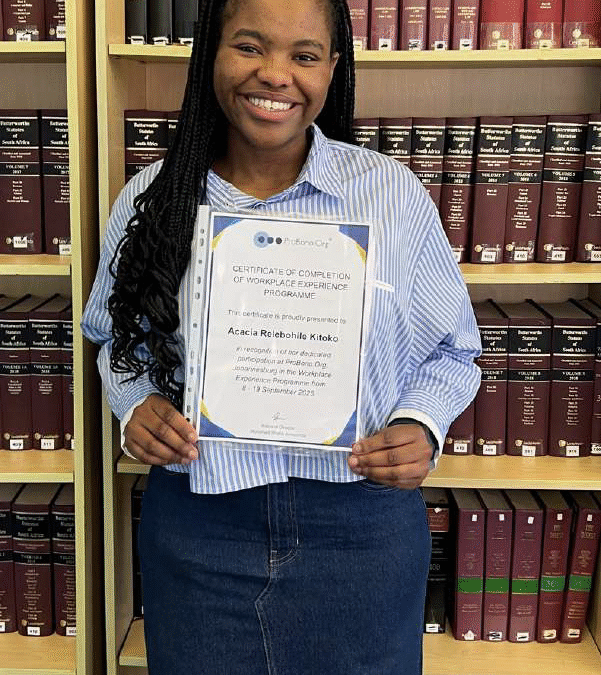
From 8 to 19 September 2025, I had the privilege of completing the ProBono.Org two-week workplace experience programme in Johannesburg. This experience was enlightening! The staff were welcoming throughout my time there. Thanks to their willingness to teach me, I completed the programme with many valuable insights.
My first one-on-one discussion with the National Director, Adv. Shafie Ameermia, summarises these insights. He encouraged me to consider deeply my vision for my legal career and the responsibility to use my legal expertise to contribute to South Africa. He stressed that the law serves real people by solving their genuine issues. Reflecting on this, I am amazed to have witnessed how ProBono.Org realises its vision. ProBono.Org aims to provide sufficient free legal aid to all who need it. According to Section 34 of the Constitution, everyone has the right to resolve disputes through the law, with decisions made in a fair and public hearing by a court or an independent tribunal. This right means little if one cannot afford legal representation, which is the reality for most South Africans. It was eye-opening to see how the staff consistently treated clients with dignity from entry to exit, ensuring this vision becomes a reality.
When Adv. Ameermia concluded his reflection on his legal career, he remarked that the human spirit is unbreakable. Difficulties drive humans to stay focused, learn, persevere, overcome, and assist others in doing the same.
During my time, I shadowed the office’s three legal interns to observe how they conducted legal consultations with clients during the various legal clinics.
- Firstly, Ms Tiisetso Maleke, who is responsible for family law and refugee law. Due to the personal nature of her clients’ matters, she emphasised the need to use her legal mind rather than her emotional mind to ensure she can advise clients as effectively as possible. Moreover, she stressed the importance of staying up to date with case law and legislation, as well as thoroughly fact-checking all legal advice she provides with the legal clinic coordinator, Ms Lesego Vakalisa.
- Secondly, Mr Jonathan Malatji, who oversees labour law and housing clinics. During his consultations, he evaluates the strengths of labour disputes to advise clients on the best course of action. He explained that his personal test for a skilled legal practitioner is their ability to negotiate and settle cases outside court.
To him, passing this test saves parties both time and money. I also visited the Labour Court with Mr Malatji for the first time, and it was inspiring to observe his passion for labour law as we discussed court documentation and filing. Regarding housing, he highlighted the problematic history of South Africa’s land system, from housing permits to title deeds, which currently hampers previously disenfranchised citizens who seek housing today.
Thirdly, Mr Ofentse Maoto, who is responsible for deceased estates and deeds. During his consultations, he assesses the validity of wills, letters of authority, and other documents to ensure the transfer of immovable property to beneficiaries. Mr Maoto and I also attended ProBono.Org’s webinar focused on the Expropriation Act. This webinar was hosted by staff attorney Ms Aphiwe Nonyukela and presented by guest Mr Jacques Marais, a partner at Fasken. I enjoyed engaging with Ms Nonyukela and Mr Maoto to reflect on aspects of the Expropriation Act that we learned about during the webinar.
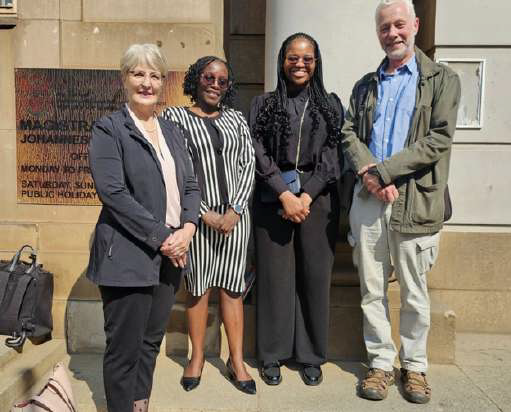
Furthermore, I shadowed Adv. Elsabe Steenhuisen and Ms Daphne Makombe, who oversee the One-Child-a-Year Campaign (OCAY) that aims to obtain legal representation for children in need. They are responsible for monitoring legal practitioners and non-legal participants to ensure that all aspects of cases are handled in the best interests of the child. I assisted OCAY in preparing case memoranda and organising court files. Adv. Steenhuisen, Ms Makombe and I visited the Children’s Court to attend a seminar on Family Housing led by David Dickson from Lawyers for Human Rights. It was exciting to be inside the Children’s Court for the first time and observe magistrates discussing the challenges families face when transferring family houses due to bureaucracy and costs.
Our second visit to the Children’s Court involved attending a family court case flow meeting. I gained insight into the difficulties of integrating systems among legal practitioners, judicial officers, SAPS, Child Welfare, and others. It was interesting to see all different parties acknowledge that mediation is an increasingly popular and preferred solution for family court matters. I also had a brief one-on-one conversation with Magistrate Natasha Mukoli, where we discussed her professional and personal views on safe and unsafe child abandonment in preparation for the University of Pretoria’s Centre for Child Law Moot Court Competition. She stressed the importance of personalising my approach to every administrative problem I face, especially when considering solutions for abandoned infants in research.
Lastly, Ms Makombe and I attended the University of Pretoria’s Centre for Child Law Moot Court Competition. I enjoyed supporting Ms Makombe with her research, which she used to evaluate the competitors. It was wonderful to see competitors share their understanding of the law and suggest their solutions to child abandonment.
What Adv. Steenhuisen, Ms Makombe, and I discussed during our excursion continues to resonate in my reflection. They emphasised the importance of visualising what personal and professional success mean for me, staying curious and asking questions of those who came before me, and ensuring that my presence is felt to influence all environments positively. This experience has not just equipped me with legal knowledge and skills, but also instilled a sense of responsibility in me and a deep understanding of the power of the law to bring about meaningful change. I am now more determined to accept my responsibility to contribute to South Africa’s legal system.


