
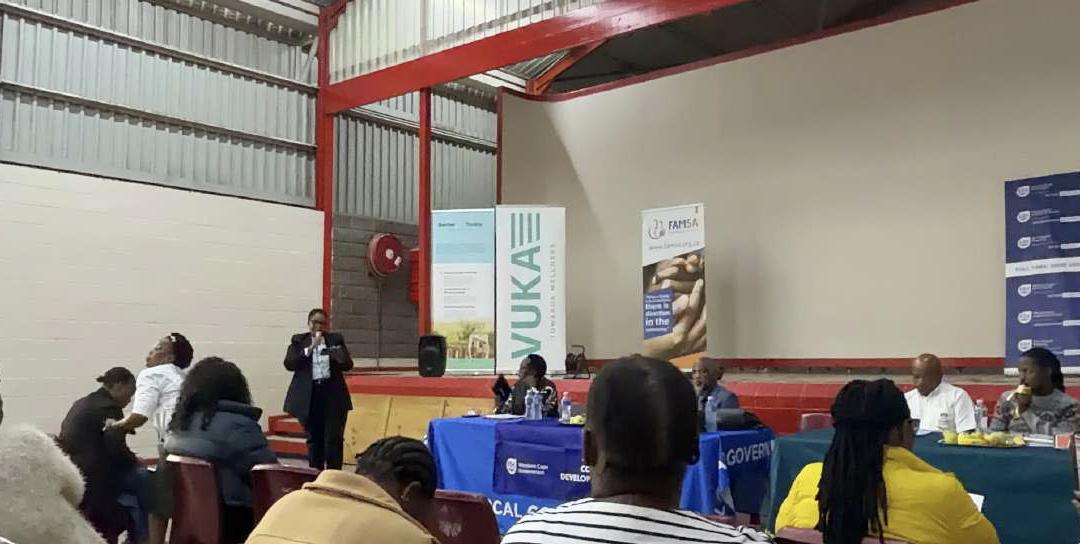
ProBono.Org participated in the annual Khayelitsha Marriage Seminar on 19 March 2026. The Department of Local Government, Public Education Office, Parliament and City Health brought together key stakeholders such as ProBono.Org, FAMSA, VUKA (Towards Wellness), Better You Today, and the Department of Social Development, Home Affairs Department and Parliament’s Public Education Office in order to educate community members about their rights related to life-long relationships, marriage and divorce.
Mr. Vuyani Xabendleni from the Public Education Office opened the seminar by emphasising the importance of public participation in legislative processes, noting that citizens should engage not only during elections but also in shaping laws. He related this to the amendments to the Marriage Bill, mentioning the efforts to simplify and modernise the country’s marriage laws by bringing them all under one legislative umbrella.
He noted that there is often confusion and inequality presently, as different types of marriages are governed by separate laws. The new bill aims to fix that by creating one clear, inclusive law that treats all marriages equally, ensures all partners have the same rights, bans child marriages by proposing that the minimum age of marriage be set at the current South African age of majority, and formally recognises unions like Muslim marriages. It is notable that same-sex unions are affirmed as fully protected under the new bill.
Although customary marriages are fully recognised in terms of the Recognition of Customary Marriages Act 120 of 1998 (“the Act”), certain aspects still had to be clarified to community members. An active debate was held on customary marriages, in which it was emphasised that in instance of polygamous marriage, the husband must adhere to the Act. This requires applying to the High Court for approval of a written contract that regulates the matrimonial property system, ensuring the new marriage is valid and existing spouses are protected. Only customary marriages can be polygamous; civil marriages cannot.
Furthermore, one cannot legally enter into a customary marriage if one is already married in a civil marriage with someone else.
Ukuthwala was explicitly rejected as harmful, and members of the public were warned not to disguise it as a legitimate cultural practice. Ukuthwala is a traditional Southern African customary practice, often described as a “mock abduction” or “kidnapping” of a woman by a man to compel marriage negotiations. It becomes problematic when it is used for purposes of child marriages or when it is done without the consent of the woman.
Advocate Siphiwo Ngobeni, who presented on behalf of ProBono.Org, also shared key points on various matrimonial property regimes. Importantly, she shared the importance of knowing the difference between marriage in community of property and out of community of property as a choice available to individuals before marriage, as both decisions have lasting financial and legal consequences.
Overall, the Marriage Seminar was a great success and ProBono.Org is privileged to have been able to participate in this collaboration.


