
Freedom Day this year marks 32 years since South Africa’s first democratic general elections on 27 April 1994. This momentous occasion fundamentally reshaped the country’s constitutional order by enshrining human dignity, equality and freedom for all. While the values and human rights of the Constitution of the Republic of South Africa, 1996 (“the Constitution”) remain a powerful framework, many individuals facing poverty, unemployment, gender-based violence, discrimination and systemic exclusion continue to experience barriers to accessing justice.
Freedom Day therefore underscores the ongoing importance of pro bono legal services in bridging the gap between rights on paper and the enforcement of human rights in the advancement of a more just and equitable society.
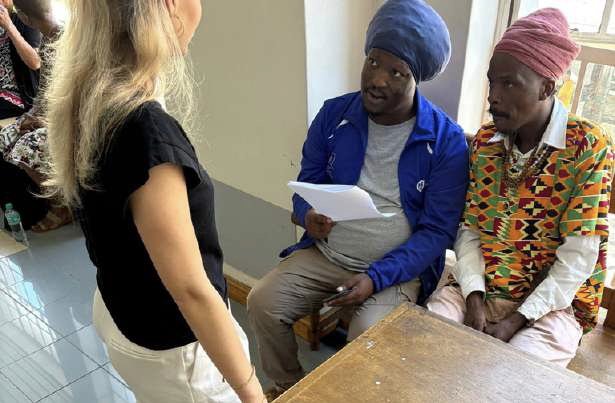
My name is Senna Knecht and I am a law student at the University of Applied Sciences in Leiden in the Netherlands. For the past five months I have volunteered at ProBono.Org’s Cape Town office. Volunteering at ProBono.Org has been an exceptional experience in which I was able to develop a broad range of skills, including analytical skill, organisational competencies and soft skills. During my time as a volunteer, I contributed to the office by supporting the weekly help desks, drafting various legal documents and assisting in the development of case files through direct client communication. I also assisted attorneys with various aspects of casework. This experience was enriching as I was able to contribute to much-needed access to justice.
I have noticed time and time again that access to justice is not equally accessible for everyone in South Africa. Due to being unable to afford expensive legal fees, more than half of the South African population had to represent themselves in court last year – without solid legal knowledge, without a clear understanding of the legal system and ultimately without having their voices fairly represented by a lawyer. Additionally, only 12.9% of litigating individuals were able to afford a private attorney last year. Although these figures may come as a surprise to some, it should be noted that the number of people representing themselves over the past five years has steadily decreased by 7%. This decrease shows that even though progress has been made in increasing legal representation for litigants, the vast majority of litigants still face challenges with obtaining legal representation.
The Constitution is the highest law in South Africa. All legislation and court orders are to uphold the Constitution. A specific part of the Constitution, Chapter 2, addresses fundamental human rights. These rights are often referred to as the Bill of Rights. Access to justice, which falls under the Bill of Rights as per section 34, allows citizens, businesses and organisations to enforce their rights and find solutions to legal disputes.
Access to justice emphasises that everyone should be able to resolve disputes in a fair manner before an independent court. However, this human right is not easily realised in practice. What barriers do individuals face when trying to enforce their rights?
Access to justice is limited due to several reasons, a few of which will be mentioned below. First, South Africa’s state-funded Legal Aid for the criminal sector is much better developed than it is for the civil sector. Approximately 89% of new matters accepted by Legal Aid are criminal in nature and only 11% are civil in nature. People who cannot afford legal services suffer the consequences firsthand by receiving very limited civil pro bono legal support.
Furthermore, the cost of legal services in South Africa is very high compared to other countries around the world. In 2013, former Deputy Minister of the Department of Justice and Constitutional Development John Jeffery noted this and conceded that legal costs were “astronomically high”.
This is very concerning considering the high levels of poverty and unemployment in the country. For the cases that are heard in court, there are significant backlogs in the finalisation of court cases. As of April 2026, more than 300 court judgments are officially late. The North Gauteng High Court has the highest number of late judgments, with 55 judgments outstanding for longer than six months. Close in second place is the Johannesburg Labour Court with 51 late judgments, and the Durban Labour Court with 31.
Late judgments contribute to the poor accessibility of justice because, as the saying goes, justice delayed is justice denied. Because access to legal services is limited for so many, vulnerable people rely on organisations like ProBono.Org for assistance. ProBono.Org is a legal clearinghouse that makes legal advice accessible to everyone by providing free consultations, obtaining legal representation for clients who cannot afford to do so, assisting with mediations and educating vulnerable communities about their legal rights. This is all done with the support of the private legal sector who are to assist on a pro bono basis. ProBono.Org assisted over 6,000 clients in 2025, and the clientele base of the organisation continues to grow each year as the demand for legal services grows.
It warms my heart that ProBono.Org and various lawyers assisting on a pro bono basis contribute to furthering access to justice. In doing so the spirit of Freedom Day is fulfilled.


